
History
Echoes of the Past
Step Into King George County’s Rich History

Historic Places


Historical Trails


Museums


Highway Markers
Learning Through Landmarks – Discover Local History Along the Way
Discover the rich past of King George County through its official historical highway markers. Each marker highlights a significant site, person, or event that helped shape the region’s story. Use the interactive map to locate each marker and learn more about the moments in history that unfolded right where you stand.
King George County Formed in 1720 from Richmond, and named for King George I. James Madison, “Father of the American Constitution” and President of the United States, was born in this county. Caroline County Formed in 1727 from Essex, King and Queen, and King William. Named for Queen Caroline, wife of King George II. George Rogers Clark, conqueror of the Northwest, passed his youth in this county. Virginia Conservation Commission, 1946
In May 1861, Confederate forces commanded by Brig. Gen. Daniel Ruggles and Maj. Robert Mayo began constructing gun emplacements at Mathias Point, which is located 2.5 miles northwest on the Potomac River close to the Virginia shore. This battery, as well as others, interfered with Union forces shipping troops and supplies to Washington, D.C. On 27 June 1861, the gunboat, USS Thomas Freeborn, commanded by Comdr. James H. Ward, shelled the batteries held by the Confederate forces. While sighting the bow gun, Ward was mortally wounded, the first U.S. Navy officer killed in action in the Civil War. Department of Historic Resources, 2009
Dr. Richard H. Stuart built a T-shaped house just southeast of here in 1859 as a summer residence for his family. John Wilkes Booth and his accomplice David Herold, guided by a local farmer, arrived here on 23 April 1865 while attempting to escape after Booth had assassinated Pres. Abraham Lincoln. The fugitives asked to spend the night and sought medical attention for Booth’s injured leg. Suspicious of his visitors and aware of Lincoln’s assassination, Stuart gave them dinner and then sent them away. He directed them to the nearby house of William Lucas, a free African American farmer, where they evicted the family and slept. Department of Historic Resources, 2017
Four miles north is Eagle’s Nest, the seat of the Fitzhugh and Grymes families, and the core of a 17th-century plantation. Lawyer and planter William Fitzhugh I (1651‚Äì1701), born in Bedford, England, immigrated to Virginia by 1674 and acquired vast land holdings in the commonwealth including Eagle’s Nest. He also represented Stafford County in the House of Burgesses. William Fitzhugh II inherited the property after his father’s death. The present house there was damaged by fire in the late 18th century and was extensively repaired and subsequently enlarged. On the grounds are an early garden and a family cemetery. Department of Historic Resources, 2006
Hanover Baptist Church, the oldest Baptist church in King George County, was organized in 1789 with a 93-member congregation. The first meetinghouse was located at Shiloh, and Elder John Shackleford served as the first pastor. The first Sunday school was established in 1833. The second meetinghouse was located at Allnutt. In the early 1840s, during the Second Great Awakening, 1,025 new members were baptized. The third house of worship was built here after James F. Jones deeded the land to Hanover Baptist Church trustees William B. Coakley, William E. McClanahan, and John A. Peed in 1873. Department of Historic Resources, 1998
The site of Port Conway is located five miles south on the Rappahannock River. Francis Conway laid out the town in 1783, and the next year the Virginia General Assembly passed an act establishing it. James Madison, Father of the Constitution and fourth president of the United States, was born at the Conway house on 16 March 1751. On 1 Sept. 1863 Brig. Gen. H. Judson Kilpatrick’s Federal cavalry shelled two Union gunboats at Port Conway that had been captured by Confederates. John Wilkes Booth, the assassin of President Abraham Lincoln, fled across the river there on 24 Apr. 1865. Little remains of the town today. Department of Historic Resources, 1999
James Madison, “Father of the Constitution” and fourth president of the United States, was born here at Port Conway on 16 March 1751, in a house that no longer stands. His mother, Eleanor Conway Madison, was visiting her family at their plantation, Belle Grove. Madison was raised in Orange County and inherited Montpelier, his father’s estate there. Madison served in the Virginia House of Delegates, Continental Congress, U.S. House of Representatives, and as Pres. Thomas Jefferson‚Äôs secretary of state. He advocated religious freedom, drafted the Bill of Rights, and was president during the War of 1812. He died in 1836. Department of Historic Resources, 2016
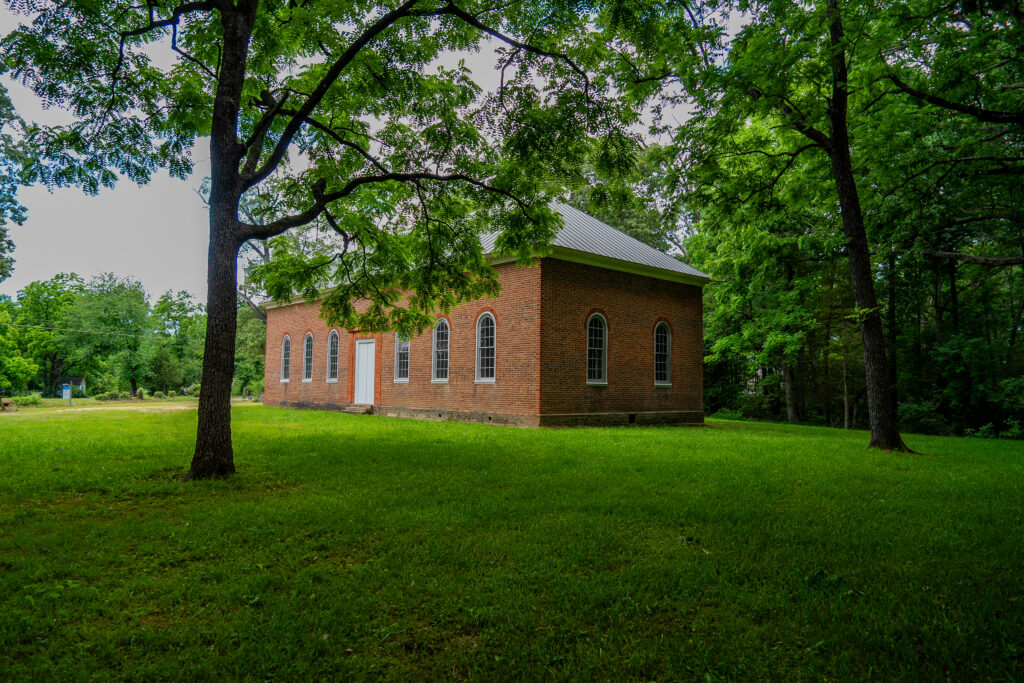
This old church was probably built before 1750. The stepping stone at the door bears the date, 1782. Near here Kilpatrick’s Union cavalry, on a raid to destroy gunboats at Port Conway, fought a skirmish, September 1, 1863. Conservation & Development Commission, 1928
Two miles north is Marmion, probably built by John Fitzhugh early in the eighteenth century and later named for Scott’s poem. About 1785 it passed from Philip Fitzhugh to George Washington Lewis, Washington’s favorite nephew, who died there. The place has come down in the Lewis family in direct line from him. The richly decorated interior is one of the best in Virginia. Virginia Conservation Commission, 1949
Displaced from their reservation land on both sides of the Rappahannock River at Nanzattico and Portobago Bay, Nanzattico Indians attacked the farm of John Rowley, known for his disputes with the tribe, on 29 Aug. 1704. When captured in Richmond County, seven Nanzattico confessed to murder; five were executed after trial. The Virginia Council deemed forty Nanzattico age 12 or older guilty of complicity and ordered them deported, while keeping the younger children as servants. In 1705, sea captain John Martin transported the adult Nanzattico to the island of Antigua, where they were sold into servitude. Department of Historic Resources, 2009
Ralph Bunche High School was built as a direct result of the Federal District Court case Margaret Smith et al. v. School Board of King George County, Virginia, which was filed in 1947. The judge ruled that jurisdictions should ensure the “equalization” of segregated school facilities for whites and African Americans. White segregationists hoped to avoid integration by constructing “separate but equal” facilities, but the NAACP quickly moved on to demanding the end of segregation altogether. Named after the noted political scientist and diplomat, Ralph Bunche High School opened in 1949 and closed in 1968 after the county desegregated its schools. Department of Historic Resources, 2012
Eight miles northeast of Route 3 and 206 is St. Paul’s Church, built about 1766. The building was in a ruinous condition in 1812 but was repaired by the State and used both as a church and as a schoolhouse. About 1828 it once more became exclusively a church. Conservation & Development Commission, 1928
Stafford County Formed in 1664 from Westmoreland, and named for Staffordshire, England. The Army of the Potomac camped in this county, 1862-63. King George County Formed in 1720 from Richmond, and named for King George I. James Madison, “Father of the American Constitution” and President of the United States, was born in this county. Department of Conservation and Historic Resources, 1988
King George County Formed in 1720 from Richmond, and named for King George I. James Madison, “Father of the American Constitution” and President of the United States, was born in this county. Westmoreland County Formed in 1653 from Northumberland and King George, and named for an English county. In it were born George Washington, James Monroe, and Robert E. Lee.